Pension and Inheritance
Pension and Inheritance
You will read in detail about the Pension and Inheritance, Inheritable and Inheritable Assets, Succession Certificates, Tarka, and 11 priorities of eligible family members. You will also read regarding Laws Under Which Payment after Death the family gets.
Details of Pension and Inheritance for Family
Let’s read in detail about Pension and Inheritance for the employees. Inheritance, generally speaking in short, is the receiving of assets [money, property, or title, etc.] by a family member, as an heir, upon the death of the previous owner of the assets. Courts generally issue Succession Certificates which explain the share of each successor/heir in the assets left behind by a deceased person.
Family Pension, as well as other death-related benefits, payable by the employer to the specific family members of the deceased employee, are not inheritable assets. These benefits are given to only those family members who have been specified in the relevant rules, on meeting the conditions prescribed therein. Laws under which payment after the death of a deceased employee is made to the specified family member/s include:-
| Sr. No | The benefit to a family member | Law/orders applicable |
| 1 | Family Pension in death-during-service and death-after-retirement both cases | Civil Servants Act, Civil Service Regulations, Pension rules/orders |
| 2 | Sum assured under Group Insurance | Federal Government Employees Group Insurance and Benevolent Funds Act 1969 and rules issued thereunder |
| 3 | Lump / Periodical grants | |
| 4 | Grant for children’s marriage | |
| 5 | Children Education | |
| 6 | A plot of land (or cash in lieu) | Prime Minister’s Assistance Packages for employees’ security-related / in-service death |
| 7 | Special Grant from the government |
Family Pension Payable
Title of the family members to the benefits listed above arises only after the death of the deceased employee. Family pension is payable from the date immediately following the date of death of the principal pensioner. For other benefits, too, the eligible family member has to formally apply along with a copy of the death certificate and pension order, and other documents. Since these benefits are received by the family member after the death of the principal pensioner, no question arises of these being the inheritable assets of the deceased on the date of his death.
Difference Between Inheritable and Inheritable Assets of the Employee
Family Pension to Eligible Members
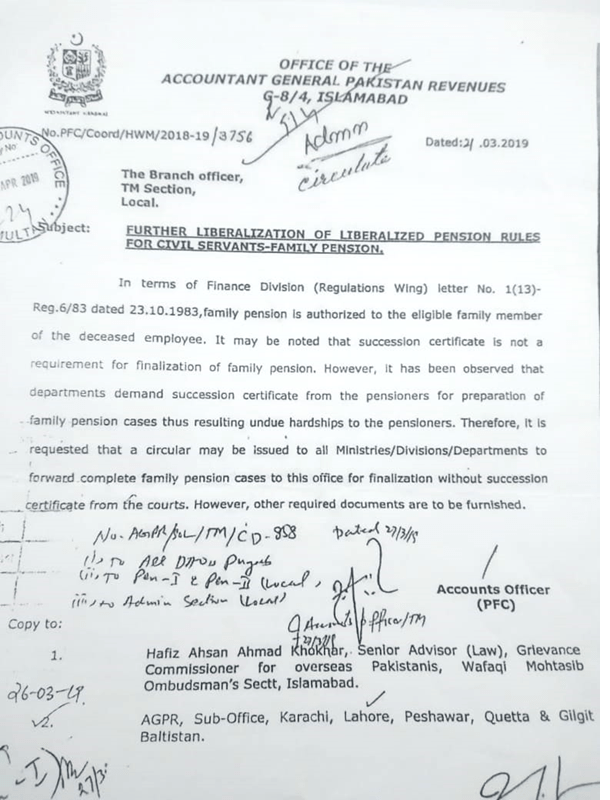
The Pension Facilitation Centre of AGPR Islamabad office advised its sub-offices at Karachi, Lahore, Peshawar, Quetta, and Gilgit through No.PFC/Coord/HWM/2018-19/3756 dated 21 March 2019, with a copy to the Wafaqi Mohtasib (copied below) that family pension they should allow to an eligible family member in terms of Finance Division O.M. No.1(13)-Reg.6/83 dated 23 Oct 1983. There is no requirement for any succession certificate for this purpose. A circular therefore they should issue to all ministries/divisions/departments for sending family pension cases without succession certificates from the court.
Federal Government Orders Regarding Eligible Family Members for Pension
(ii) failing widow or husband, as the case may be, the pension they should divide equally among the surviving son(s) not above 21 years and unmarried daughter(s) / widowed daughter(s) / divorced daughter(s) till marriage/re-marriage.”
(iii) failing (i) and (ii), to the eldest widow of a deceased son of the Government servant for 10 years or un-expired portion of 10 years;
Other Beneficiaries
(iv) failing (i) to (iii), to the surviving son below 21 years of age of a deceased son of the Government servant for 10 years or the unexpired portion of 10 years;
(v) failing (i) to (iv), to the eldest unmarried daughter below 21 years of age of a deceased son of the Government servant for 10 years or the unexpired portion of 10 years.
(vi) failing these, to the eldest widowed daughter of a deceased son of the Government servant for 10 years or un-expired portion of 10 years;
(b) In the event of no pension payable under clause (a), the family pension they should grant for a period of 10 years or an unexpired portion of 10 years—
(i) to the father; for life,
(ii) [failing the father], to the mother; for life,
(iii) [failing the father and the mother], to the eldest surviving brother below the age of 21;
(iv) [failing (i) to (iii)], to the eldest surviving unmarried sister; if the eldest sister marries or dies then to the next eldest unmarried sister for life or till her marriage;
(v) [failing (i) to (iv)], to the eldest surviving widowed sister for 10 years or an unexpired portion of 10 years.
Priorities of family members 1st to 11th
Stating in simple language, priorities of family members in receiving family pension may be explained from First to Eleventh as under. [The overriding condition must be met before the family pension is claimed by or allowed to a family member having a lower priority than that of a member having higher priority].
First Priority
(a) widower of a female pensioner, or sole widow of a male pensioner; otherwise
(b) (i) If the pensioner has more than one wife, and the number of surviving wives and children (less than 21 years old) does not exceed 4, then the family pension should share equally to all of them; otherwise
(ii) If the number of surviving wives and children (less than 21 years old) exceeds 4, then each widow should allow 1/4th, and the remaining if any should share by the children.
Note 1: “children” exclude those over 21 years, and married daughters.
Note 2: a widow or divorced or unmarried daughters have Second Priority.
Second Priority
Failing any member with First Priority, the pension they should divide equally among the surviving son(s) less than 21 years old and unmarried daughter(s) / widowed daughter(s) / divorced daughter(s) till marriage/re-marriage.
Third Priority
Failing members with First and Second Priorities, the eldest widow of a deceased son of the Government servant for 10 years or un-expired portion of 10 years;
Fourth Priority
Failing members with First to Third Priorities, to the surviving son below 21 years of age of a deceased son of the Government servant for 10 years or the unexpired portion of 10 years;
Fifth Priority
Failing members with First to Fourth Priorities, to the eldest unmarried daughter below 21 years of age of a deceased son of the Government servant for 10 years or the unexpired portion of 10 years.
Sixth Priority
Failing members with First to Fifth Priorities, to the eldest widowed daughter of a deceased son of the Government servant for 10 years or un-expired portion of 10 years;
Seventh Priority
Failing members with First to Sixth Priorities, to the father for life.
Eighth Priority
Failing members with First to Seventh Priorities, to the mother for life.
Ninth Priority
Failing members with First to Eighth Priorities, to the brother less than 21 years of age.
Tenth Priority
Failing members with First to Ninth Priorities, to the unmarried sister for 10 years or the unexpired portion of 10 years;
Eleventh Priority
Failing members with First to Tenth Priorities, to the widowed sister for 10 years or the unexpired portion of 10 years;
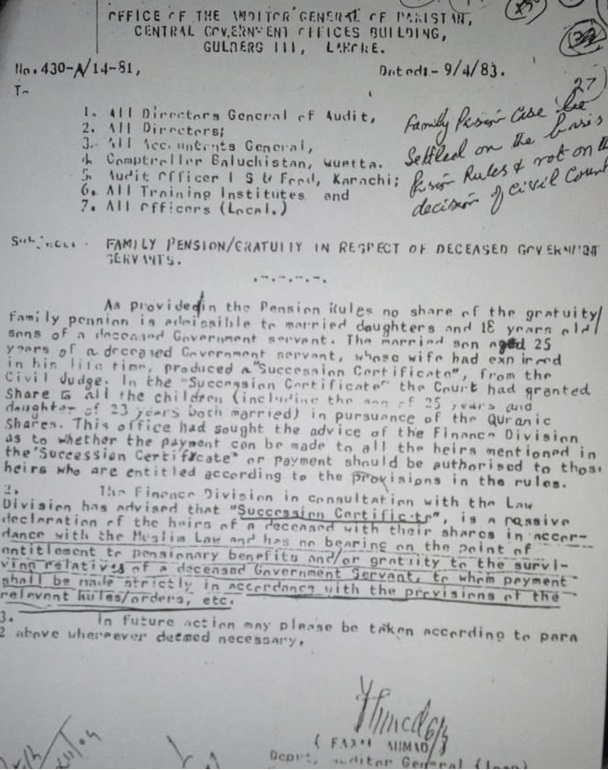
Notification of AGP Regarding Pension and Inheritance
OFFICE OF THE AUDITOR GENERAL OF PAKISTAN
CENTRAL GOVERNMENT OFFICES BUILDINGS,
GULBERG III, LAHORE
No.430-A/14-81 Dated 9/4/83.
To
- All Directors General of Audit,
- All Directors
- Comptroller, Baluchistan, Quetta
- All Accountants General
- Audit Officer I S & F, Karachi
- All Training Institutes, and
- All Officers (Local.)
Subject: FAMILY PENSION/GRATUIT IN RESPECT OF DECEASED GOVERNMENT SERVANT
As provided in the Pension Rules, no share of the gratuity/family pension is admissible to the married daughters and 18 years old sons of a deceased Government servant. The married son aged 25 years of a deceased Government servant, whose wife had expired in his lifetime, produced a “Succession Certificate” from the Civil Judge. In the “Succession Certificate,” the Court had granted share to all the children (including the son of 25 years and daughter of 23 years both married) in pursuance of the Quranic Shares. This office had sought the advice of the Finance Division as to whether the payment they should make to all the heirs mentioned in the “Succession Certificate” or to those heirs who have entitlement according to the provision in the rules.
- The Finance Division in consultation with the Law Division has advised that “Succession Certificate” is a passive declaration of the heirs of a deceased with their shares in accordance with the Muslim Law and has no bearing on the point of entitlement to pensionary benefits and/or gratuity to the surviving relatives of a deceased Government Servant, to whom payment shall be made strictly in accordance with the provisions of the relevant rules/orders, etc.
- In the future action may please take according to para 2 above wherever deemed necessary.
Sd/-
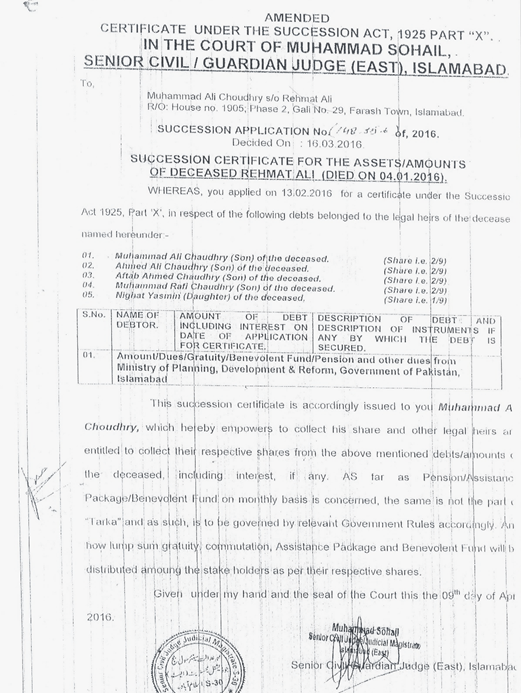
As far as Pension / Assistance Package / Benevolent Fund on monthly basis is concerned, the same is not part of “Tarka” and as such, is to be governed by relevant Government Rules accordingly.
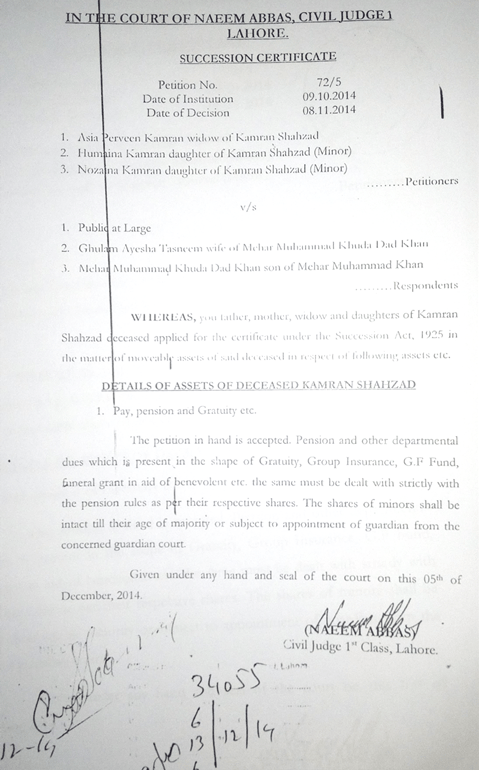
Pension and other departmental dues which are present in the shape of Gratuity, Group Insurance, G.P. Fund, funeral grant in aid of benevolent, etc, the same must be dealt with strictly with the pension rules as per their respective shares.



Comments
Post a Comment